Application Notes
Automated Stud Welding: One Pass, Three Stud Sizes
How the H3 places studs of different sizes in one pass on new energy and cabinet sheet metal — and where that matters most.
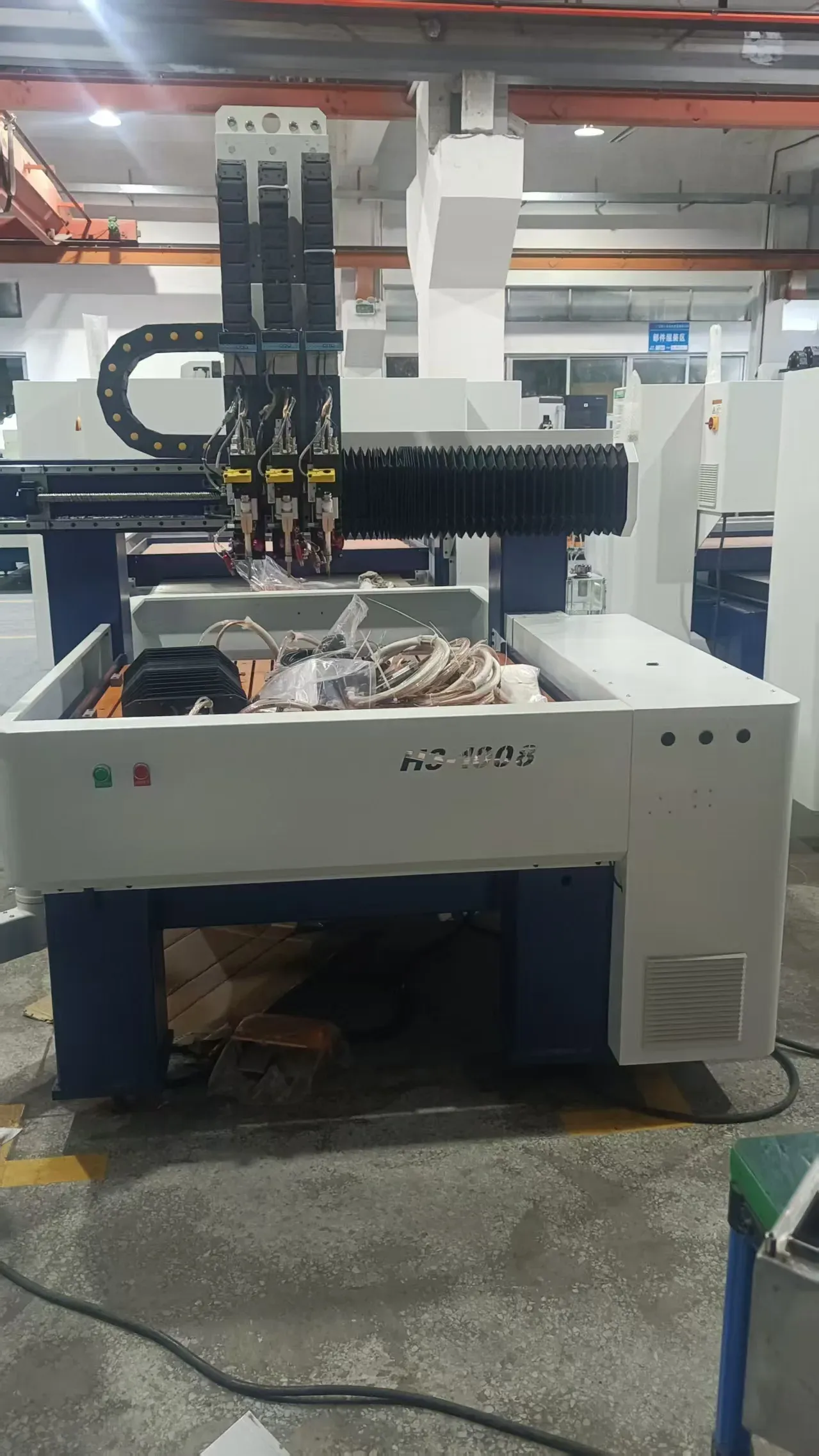
A stud that leans fails at assembly, and no downstream operation fixes it cheaply. Stud welding on enclosure panels therefore comes down to three things: the torch meeting the panel square, welding parameters that repeat from part to part, and the ability to place different stud sizes on the same part without a second pass. The H3 series is built around those three requirements.
One Pass, Several Stud Sizes
The H3 carries three welding guns and three feeders, so studs of different specifications can be welded on the same product in one pass instead of one size per run. Stud diameter covers 3 mm to 8 mm and stud length covers 6 mm to 30 mm — the common hardware range on enclosure panels — with welding efficiency stated at 15 to 30 studs per minute.
A laser unit is available as an option on the H3. The series is used for stud welding on new energy sheet metal parts, on sheet metal parts for mechanical equipment, and on chassis and cabinet sheet metal — three groups that follow the same pattern of work: formed panels carrying a spread of hardware that has to be placed accurately and stay square.
The Verticality Check That Decides Assembly
A stud welded at a lean will not thread, and the cause is generally the relationship between the torch and the surface it is welding onto. The H3 controls the verticality between the welding torch and the workbench, which is the mechanical basis for keeping the stud square to the panel surface. That is the specification to test in a demonstration: weld a full pattern, then check the studs with a square rather than by eye. On a panel carrying a dense pattern of studs, the finished assembly is only as good as the worst one on it. That relationship is set by the machine rather than by the operator's hand, so the verticality repeats across a pattern rather than depending on the first stud.
Repeatability: The Recipes That Hold It Steady
Repeatability comes from two features working together. Welding recipes are saved per job, so a process that has been set once is recalled rather than re-tuned from memory, and the welding voltage uses bus-type stepless adjustment instead of fixed steps. Machining accuracy is specified at plus or minus 0.1 mm. In practice that means the second batch and the twentieth batch follow the same recipe as the first, provided the recipe is stored and the operator selects the right one. A stored recipe is also what makes a job portable between shifts: whoever runs the machine calls up the number rather than tuning by feel.
The Programming-Free Part
The H3 uses a programming-free CNC system that imports DXF drawings, so the stud pattern comes from the drawing and a general worker can operate the machine; reduced labor cost is the stated benefit. The pattern is read from the file, so the position of every stud is settled at the desk rather than at the machine, which is where stud-position errors begin on manual work. It also means the drawing office, not the welding bay, holds the accuracy of the pattern: if the file is right, the studs land in the same place from panel to panel, within the machine's stated accuracy.
Sizing the Platform to the Panel
Four models cover the range: H3-1020 at 1000 x 2000 mm, H3-1325 at 1300 x 2500 mm, H3-2030 at 2000 x 3000 mm and H3-2040 at 2000 x 4000 mm. Z-axis travel is 300 mm, movement speed is 1000 mm/s and total power is 7.5 kW on all four models; what changes with the panel size is the envelope — and, with it, the machine weight, from approximately 2000 kg to 2800 kg. Machine size goes from 3500 x 2100 x 2700 mm to 5500 x 3100 x 2700 mm, so the bay is a simple check. The panel still decides the model, so measure your largest cabinet side or enclosure panel first and let the envelope follow from that measurement.
What to Send for a Stud Welding Recommendation
Send the panel size, material, stud specifications and the stud pattern drawing, and our team will confirm the model from H3-1020 to H3-2040 and the gun and feeder configuration that matches the pattern — a specification you can compare directly against the panels you run.